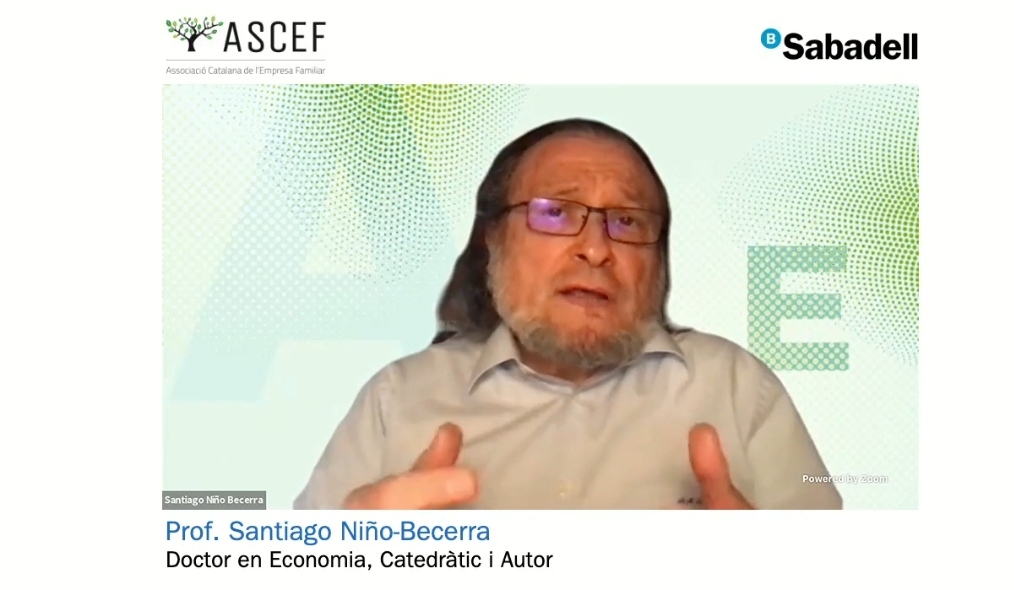
Niño-Becerra and Sánchez-Llibre agree on highlighting the worth of family businesses and the importance of staying alert to opportunities

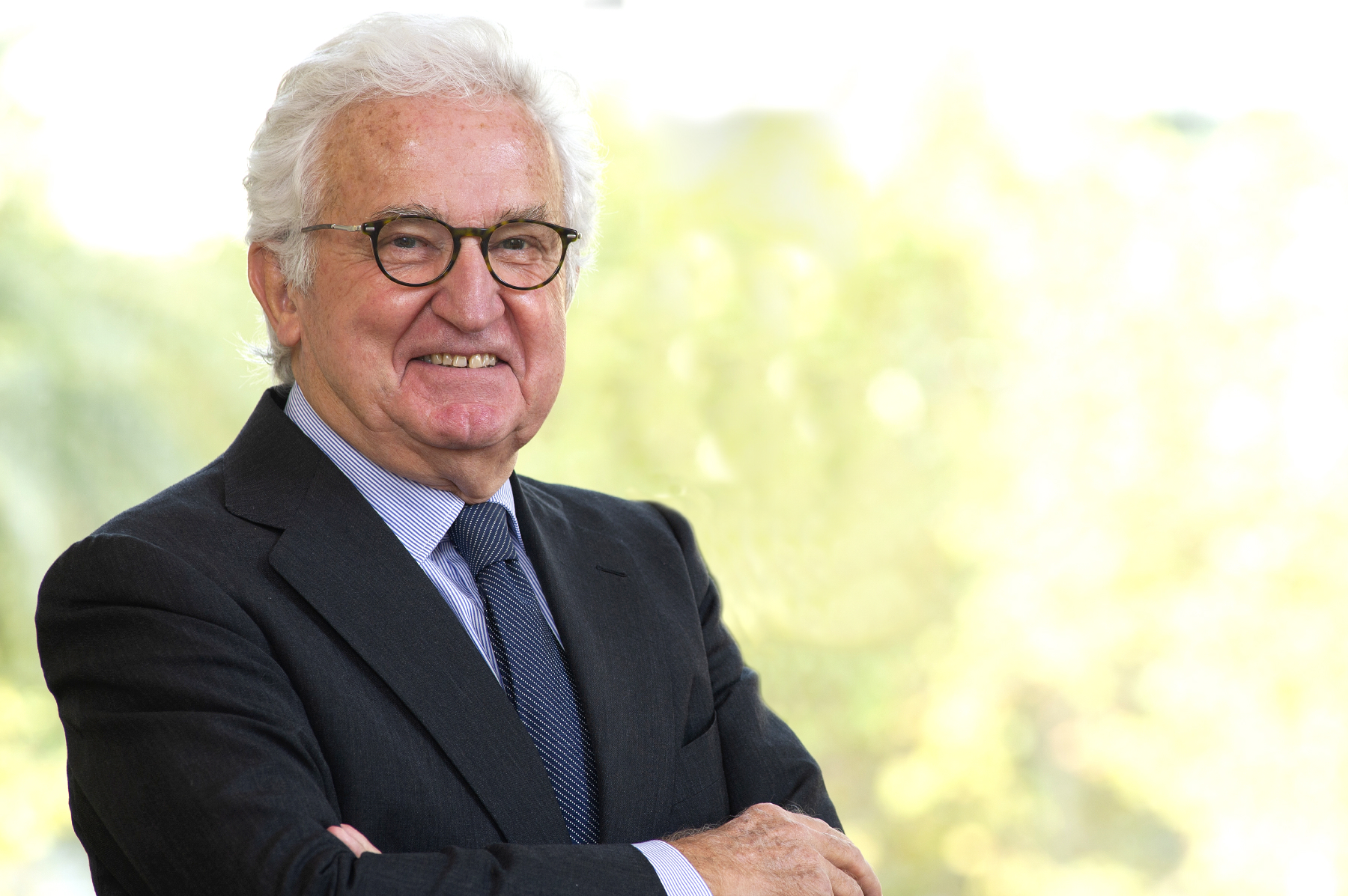
Santiago Niño-Becerra, who is a Doctor of Economics, professor and author, and Josep Sánchez i Llibre, the President of Foment del Treball Nacional, were among the participants at the 22nd Ordinary and Extraordinary Assembly of the Catalan Association of Family Businesses (ASCEF), which was held online on Tuesday, October 6.

Professor Niño-Becerra gave a talk entitled The Breaking of Trends: The New Normal, in which he examined the situation caused by a pandemic “that has broken economic trends.” He added that “to find a situation in Spain similar to the one experienced between the months of December and May we have to go back to the Civil War.”

The Professor explained that Spain’s main problem is “tax fraud” but that the country also “has a problem with income and expenditure, and a major problem with productivity.” In Niño-Becerra’s view, the Covid-19 virus and its consequent crisis has had a far greater effect on Spain “because its economy was already bad previously.”

The survivors of this situation will be those with knowledge tools to navigate this complex world, those who master innovative tools or those with a good liquidity cushion,” he said. “It will be important to create added value and to specialise; to be a sectoral leader: to be in the upper layer of added value and productivity.”
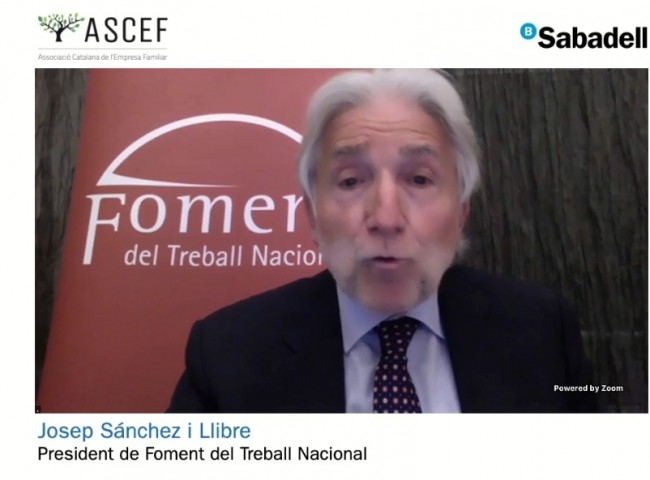
Josep Sánchez i Llibre, the President of the Foment del Treball Nacional

The Assembly was closed by Mr Sánchez i Llibre, the President of Foment del Trebrall, who said that “employers are the only ones who can overcome the crisis and salvage the current situation because we generate employment and wealth.

The crisis will generate new opportunities that family businesses will have to put into practice,” said Mr Sánchez i Llibre, who called for the general budgets for 2021 “to be a great stimulus for economic recovery, with much public investment to increase productivity, stimulate demand and boost the economy.

Today’s economic situation is very delicate,” he added before acknowledging “the great effort made by family businesses” in this context.

The 85% of Catalan family employers fear that a lack of political consensus will lead to the late arrival of the European recovery funds

Barcelona, Octobrer 7, 2020.- 85% of Catalan family businesses believe it is unlikely that the European recovery funds will arrive promptly, mainly due to the lack of agreement among politicians. “Not only because of the changing views within the EU but also because of the lack of consensus among our country’s politicians, which generates a negative image internationally that damages our capacity of influence,” said Amadeu Jori, the President of the Catalan Association of Family Businesses (ASCEF). “These funds are a vital instrument for economic recovery.

With regard to the measure announced today by Spanish Prime Minister Pedro Sánchez to advance a first payment of 27.436 billion euros from these funds, the ASLEF President said that this is “a good initiative that is in tune with what we employers are calling for.

At a time such as this, ASCEF members say that their principal concern is falling sales, followed by employee safety and labour reform. In an opinion poll canvassing Association members, the employers responded that, in parallel to the political debate, they are already taking action to address the crisis. This mainly involves innovating and creating new products, reducing costs, improving training to increase productivity and promoting digitisation.

In Mr Jori’s view, these initiatives alone are insufficient and it is also necessary for public administrations to stimulate the economy and apply measures to protect companies and jobs.

As a consequence of the situation experienced by companies, 68% of family employers believe that the economy will not show a quick recovery but will do so in the shape of a letter K; that is, first a sharp decline followed by a progressive recovery although this will not be across the board but will relate to sectors.

In the face of the second wave of the pandemic, 61% of Catalan employers think that the central government will be forced to choose between economy and health, while 37% believe that this will depend on the intensity of infections. In this regard, employers stress the importance of rigour in the application of protective measures and call for responsibility.

Furthermore, half of Catalan family employers (51%) believe that Covid-19 and the measures that have had to be taken have strained relations between regional institutions and central government.

The ASCEF is an organisation of family employers that draws over 100 companies representing the economic fabric of Catalonia. Family businesses account for 88.3% of all private companies, contribute 69% of Gross Value Added (GVA) and generate 76% of private jobs.

THE ASCEF Board of Directors is renewed

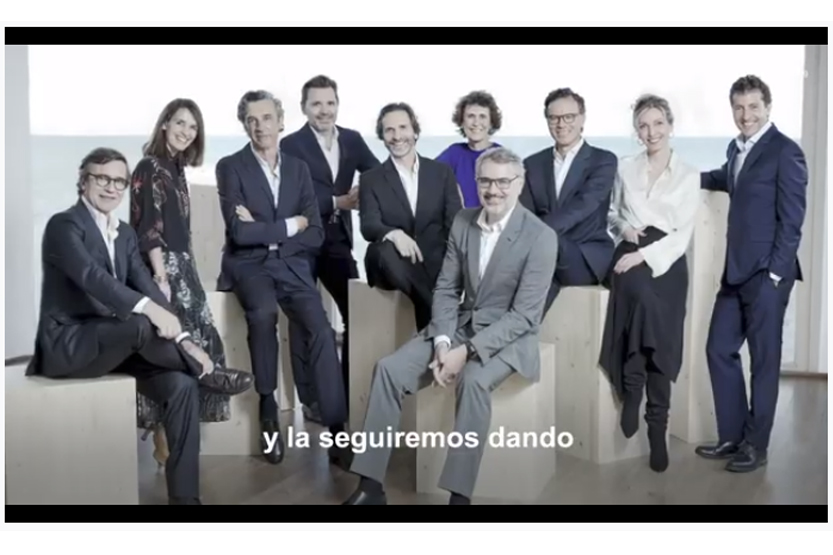
The Catalan Association of Family Businesses (ASCEF) announced during its 22nd Ordinary and Extraordinary Assembly on Tuesday that its Board of Directors is to be renewed, with five newcomers to replace four departing members. The governing body has also decided on a change in the presidency of the Executive Committee of the ASCEF Forum, the group that draws young members of business families.

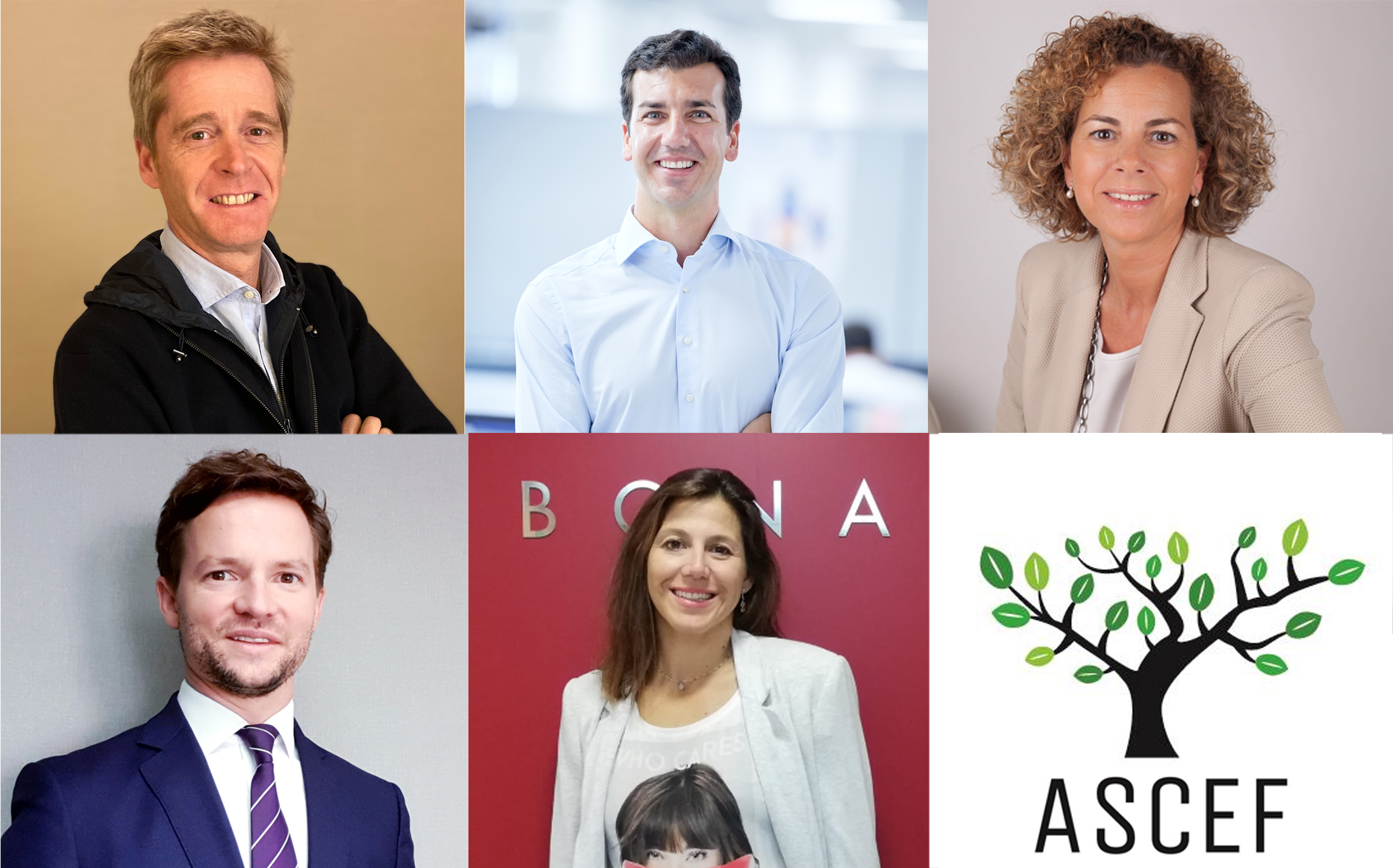
In accordance with the Association’s Statutes, the Board of Directors is renewed every three years. Amadeu Jori, on behalf of Jori Armengol & Associats, will retain the Presidency and will be joined by new members Ricard Aubert, for Simon Holding, Ignasi Botet for Caboel, Albert Campabadal for the Grupo Sifu, Diana Ganduxer for Grup Bonanova and Eva Lluch, for Lluch Essence.

The outgoing members are Immaculada Amat, on behalf of Amat Immobiliaris, Antoni Cammany, for EPI – Industries Family of Companies, Jesús Mora for JEMI, and Jordi Torres for Santiveri. ASLEF would like to thank them for their dedication and work on the Board over recent years on behalf of our members.

With the changes, the composition of the Board is as follows:

The change of the Presidency in the Executive Committee of the ASCEF Forum announced at the Ordinary and Extraordinary Assembly will see Ricard Oller replace Albert Campabadal, who remains part of the management body that draws young people aged 18-45 from Catalan business families.

The other members of the Forum’s Executive Committee are Carlos Alsina, Albert Borràs, Olga Carbó, Anna Guixà, Marc Morillas, Míriam Pujol, Guillermo Vidal i Juan Enrique Yxart Romeu.

Ana Fisas: “The present situation calls for perseverance, decisiveness and energy, three qualities that we women possess”

The new normal and the second wave of the pandemic require the business fabric to adapt and react to events. For Ana Fisas, the President of the Vamos a Compartir” (We will share) group, which comprises 30 businesswomen and forms part of the Catalan Association of Family Businesses (ASCEF), the increasing numbers of women in managerial positions is a differential value for many companies “because the present situation requires decisiveness, perseverance and great energy, three qualities that we women possess.”

In this new reality, it is important to facilitate work-life balance for both men and women through measures that focus on flexible schedules and physical presence at company premises. “However, this is only possible if the employer introducing these measures shows sensitivity and if the employee shows individual responsibility and commitment,” she says.

Ms Fisas sees our society as “open and committed” although there is still much to do in the areas of gender equality, access to decent work, poverty and various others.

The “Vamos a Compartir” group seeks to promote debate on issues related to social justice and the empowerment of women.

Catalan family businesses call for temporary lay-offs to be extended to all the sectors and companies that need them

Barcelona, September 07th, 2020.- The Catalan Association of Family Businesses (ASCEF) has asked the Spanish government to expand temporary lay-offs (known as ERTEs in Spanish) to all economic sectors, not just those regarded as having been most affected by the pandemic, such as tourism.

In the view of ASCEF’s President, Amadeu Jori, this extension “should include all the companies that require it and continue through 2021 so that activity can be maintained. The problem is not only restrictions on movement or limitations on capacity and schedules, but the slowdown in the economy and the reduction in consumption”. For ASCEF, it is not a good solution for ‘outbreak’ ERTEs to only be applied to companies that operate in a city placed under lockdown or that are subject to restrictions.

Given this situation, it is important for the proposals to be realised and an agreement reached as quickly as possible. “There are many medium or small family businesses that are less resilient, so their survival may depend on their obtaining this extension of aid,” Mr Jori adds. The ASCEF President believes family businesses remain committed to employment and the region “but the situation is reaching breaking point and there is great uncertainty about what will happen in the coming months.

Family businesses in Catalonia account for 88.3% of all private companies, contribute 69% of the Gross Value Added (GVA) and generate 76% of private jobs. They view it as necessary to maintain the same conditions for ERTEs, together with subsidies for Social Security contributions.

In addition, ASCEF has also called on the government to make large improvements in efficiency when paying workers, avoiding delays and remedying those that currently exist.

Puig, supporting the #DamosLaCara movement: “We can’t propose a way out of the crisis without involving the business fabric and this includes family businesses”

The members of the Catalan Association of Family Businesses (ASCEF) are an example of the employers and employees all over Spain who are promoting the #DamosLaCara (We show our resolve) movement. This is an initiative that demonstrates the commitment of family businesses to overcoming the present health and economic crisis, highlighting their contribution to employment and economic recovery. Puig, a century-old fashion and fragrance company, is one.

One of the characteristics that defines a family business is its time-based approach“, explains Marc Puig, the company’s CEO. “What drives us is: what do we have to do now for this to remain sustainable so we can leave a legacy to the next generation? But not just a sustainable company, but a sustainable world: I don’t want to ruin the territory where it will have to take place”, he adds.

Puig, which is today under its third generation of owners, was one of ASCEF’s members to have collaborated during the pandemic and put itself at the service of society. The company adapted its production line in Vacarisses to make gowns and masks and also launched a hand cleansing gel, as María Teresa Valls, the Manager of the factories in Barcelona and Vacarisses, explains: “We all work together and have contributed with a donation of 500,000 gels to hospitals and care homes”.

We were really moved by a video made by our colleagues who had to stop working at the Alcalá plant. They referred to those of us who kept working as ‘heroes’. It was also very moving when we saw the first bottles of gels leave the production line,” Ms Valls says. “Just remembering it makes me feel emotional again.”

Mr Puig recalls that “one of the first shipments that my grandfather sent out was sunk by a German submarine, and he started again from scratch; but then came Spanish flu, two world wars and the Spanish Civil War. That’s why when we think that we have a problem with the coronavirus, I remember that he had it much worse and survived; we will do no less.”

But now we are faced with an economic crisis and we can’t propose a way out without taking the business fabric into account. And the business fabric in Spain involves family businesses”, Mr Puig says. “We have shown our resolve and we will keep doing so to drive this country forward.”

The #DamosLaCara (We show our resolve) platform is a citizens’ movement promoted by employees and employers from all over Spain. It highlights the commitment of employees and employers to society as a whole and publicises the endeavour and important work undertaken by family businesses in the country through their economic and social contributions.

University Chairs in Family Business to embrace the new forms of post-pandemic business management

University Chairs in Family Business are aimed at fostering and promoting the creation of businesses and entrepreneurship as well as knowledge management. They also act to bring universities closer to the reality of Catalonia’s business fabric. For this reason, the current situation resulting from the Covid-19 pandemic will have a bearing on the forthcoming 2020-21 academic year.

Fernando Álvarez, the Deputy Director of the Chair in Family Business and Business Creation at the Abat Oliba CEU University, says that “among many other types of content, it will be necessary to explain the new forms of business management, new needs for leadership, changes in the globalisation model and value chains.

In addition, Mr Álvarez believes that in 2020-21, University Chairs in Family Business should explain “the importance of concepts that have become essential, such as trust, sustainability or responsibility.”

In his opinion, they should also address “the need to master the instruments of public policy assessment that improve their management and efficiency.”

Looking forward, Mr Álvarez says that “family businesses represent most of the values that society requires from the business fabric, which is a very great responsibility but also a challenge that I am sure they will gladly accept“.

There are many examples of family businesses that have gone out of their way to overcome the unique circumstances we have experienced, generously and selflessly contributing their knowledge and resources and demonstrating their commitment to the environment. We must continue to highlight the distinguishing and necessary elements of family businesses”.

In Catalonia, the Catalan Association of Family Businesses (ASCEF) sponsors five Chairs: at the University of Barcelona, the University of Girona, the University of Lleida, the International University of Catalonia and the Abat Oliba CEU University. More than 25 teachers are involved in these Chairs, the first of which began in 1998, while over 400 students have already received training.

TOUS works with #DamosLaCara: “Our hope is that the reputation of businesses has changed and that society sees employers in a different light”

Employees and employers throughout Spain are promoting the #DamosLaCara (We show our resolve) movement, an initiative that demonstrates the commitment of family businesses to overcome the present health and economic crisis on the basis of their contribution to employment and economic recovery. The members of the Catalan Association of Family Businesses (ASCEF) are participating and collaborating with this platform, as is the case of TOUS, a global jewellery brand that boasts a presence in more than 50 countries and has over 700 stores.

Now under its third generation of owners, TOUS is celebrating its centenary this year in the shadow of Covid-19, having collaborated and assisted the health system during the most difficult period of the pandemic: “We adapted the production equipment in our factory where we have laser machines and began to make the small components needed for the ventilators required in hospitals”, explains Rosa Tous, the company’s corporate vice president.

In addition, the company re-routed its Mother’s Day campaign, which was held in full lockdown, “out of consideration for those giving birth at this time.” “What we did was to provide acknowledgement of each of these mothers so that once the pandemic is over they will be able to visit a TOUS shop to collect their gift,” Ms Tous explains. “We registered over 20,000 mothers, who have thanked us very much for this initiative,” she adds.

Looking forward, Ms Tous adds that “My hope is that the reputation of companies at this time has changed. And that society sees employers in a different light”.

TOUS’s corporate vice president says that “we have always been keenly interested in jewellery in our family, even when we were little girls. Perhaps this explains why, when we grew up, we had no hesitation in continuing with the family business”.

There is a set of values that are very much part of the family: perseverance, endeavour, outside-the-box thinking, passion, teamwork, creativity. These are values that our parents have passed on to us and that we try to convey them to the rest of the company too”, she says.

The #DamosLaCara (We show our resolve) platform is a citizens’ movement promoted by employees and employers from all over Spain. It highlights the commitment of employees and employers to society as a whole and publicises the endeavour and important work undertaken by family businesses in the country through their economic and social contributions.

Simon, supporting the #DamosLaCara movement: “It is very important to stay calm as this conveys confidence to the team”

The member companies of the Catalan Association of Family Businesses (ASCEF) are among the group of employees and employers in Spain promoting the #DamosLaCara (We show our resolve) movement. Simon, a company that has been specialising in lighting technology solutions since 1916, is just one example of this collaboration. Esteban Bretcha, its CEO, and Emili Trunica, Chief Human Resources Officer, explain in a video how they have experienced the situation resulting from the health and economic crisis.

We have been thinking about making good use of this time by organising ourselves internally. This virus, this crisis, will not last forever and when we emerge from it we will need to be fully ready”, Mr Bretcha explains. “We regarded it as very important to stay calm because this enables us to convey confidence to the whole team in the future.”

The general manager of the century-old family business, which is now under its fourth generation of owners, explains that “at the beginning the management met and decided to make a list of those day-to-day things we had pending and which we never had time for”. “This gave meaning to time, to our people, who understood that they were doing something useful; and now that everything is starting to move again we find that we are better prepared”, Mr Bretcha adds.

Meanwhile, Mr Tunica identifies the issues that affect employees and their day-to-day routines more directly: “The priority has always been to protect everyone’s health as well as to support them in coping with this tough situation. We created an exclusive portal on the coronavirus which, in addition to explaining what was happening, enabled employees to share experiences on support, innovation and training; and this united us even more”.

We have supported over 400 employees in the production centres who, by showing a high level of commitment, have ensured each day that our products have reached customers and especially the field hospitals that have been created“, Mr Tunica continues.

I want to highlight all those examples of commitment, solidarity, teamwork and adaptation that our employees have provided over these months.”

The #DamosLaCara (We show our resolve) platform is a citizens’ movement promoted by employees and employers from all over Spain. It demonstrates the commitment of employees and employers to society as a whole and publicises the endeavour and important work undertaken by family businesses in the country through their economic and social contributions.

The hotel sector reinvents itself and trusts in domestic tourism

The Covid-19 pandemic has impacted the hotel sector considerably, not only as a result of having to close during the months of lockdown but also due to the current slowdown in demand. A number of reports have indicated that recovery will depend mainly on domestic tourism and suggested that the choice of hotel by those who can take holidays will be based on their confidence in the establishment’s health and hygiene measures and the quality of its service.

Grup Bonanova is a holding company presided by Mariano Ganduxer and whose brands are City Hotels Hispania (CHH) and Hoteles Atenea. An ASCEF member, it is a good example of how to adapt to such difficult circumstances. “We have developed a rigorous opening protocol that includes the new procedures for guaranteeing the health and safety of employees and customers. This has involved more frequent cleaning and the use of specific approved products; also less textile decoration, the removal of paper (menus, information in rooms etc.), the introduction of new formulas for breakfasts and online check-in and check-out, among other measures”, explains Diana Ganduxer, the co-President of the Group.

This new way of organising hotels counts with the collaboration of customers “as everyone is aware that this is a unique situation that requires exceptional safety and hygiene measures for the benefit of all. This effort on our part gives our customers peace of mind and is the key to being competitive,” Ms Ganduxer explains.

Despite all this and a confidence in the future, the sector’s prospects remain uncertain. “At present, the occupancies forecast for this summer are no greater than 30% and the prices are worse than in the 2008 crisis. However, despite all the uncertainty surrounding us, as a family business and economic driving force we have partially resumed activity because we want to be part of the recovery and convey confidence to our teams”, she adds.

If you need more information contact us ascef@ascef.com