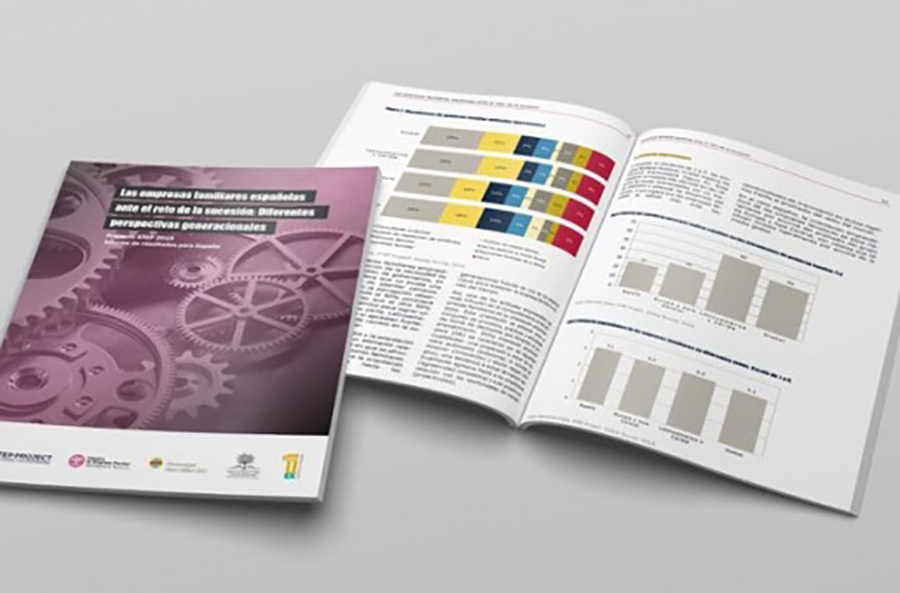
Over 70% of today’s family business leaders admit to having no succession plan

  • The study, conducted by the STEP Project Global Consortium, enjoys the collaboration of over 40 universities from different parts of the world and the participation of over 1,800 family businesses from 33 countries from 5 geographical regions
  • The Catalan Association of Family Businesses (ASCEF) sponsors 5 University Chairs in Family Business in Catalonia

More than 70% of the present leaders of family businesses admit to having no succession plan. The remainder believe that a formal succession plan increases the possibility of the manager reflecting on their plans for the future. Spanish family businesses are on a par internationally with regard to the existence of succession plans (28% in Spain, as in Europe and Latin America, compared to 30% globally).

Similarly, the study shows that Spanish family businesses address these processes with a strong leaning towards the structuring of family governance. This can lead to guidance and agreement on succession processes and to encourage family participation and involvement in future stages of the business project. However, these businesses are less well-equipped with regard to the structures and mechanisms of corporate governance (boards of directors, the existence of external directors etc.), which are also key to channelling the transition in the management.

These are some of the conclusions from the study on the way in which family businesses relate to succession, with special attention to different generational perspectives. It was conducted by researchers from the Chair in Family Business of the University of Valencia, the Chair in Family Business and Business Creation from the Abat Oliba CEU University and the University of Extremadura, which form part of the STEP Project Global Consortium (Successful Transgenerational Entrepreneurship Practices). These research groups collaborate closely with family business associations in their areas of reference: AVE (Valencian Business Association), ASCEF (Catalan Association of Family Businesses) and AEEF (Extremaduran Association of Family Businesses).

The Catalan Association of Family Business (ASCEF) sponsors 5 Chairs in Family Business in Catalonia at the Universities of Barcelona, Girona, Lleida, Abat Oliba CEU and the International University of Catalonia. These form part of a network of Chairs in Family Business throughout the country.

The Spanish family businesses participating in the study belong mainly to the service sector (69%), 15% of them conduct their activity in the primary sector and 16% in the secondary sector and are slightly larger than the national averages. Similarly, the leaders of the participating family businesses have an average age of 45 and the majority belong business families that are second or more generation.

The results of the study indicate that 28% of Spanish family businesses have a succession plan. Viewed from another angle, over 70% of current family business leaders admit to not having one. These figures are very similar in Europe and Latin America and representative of the study’s entire global sample (figure 13).
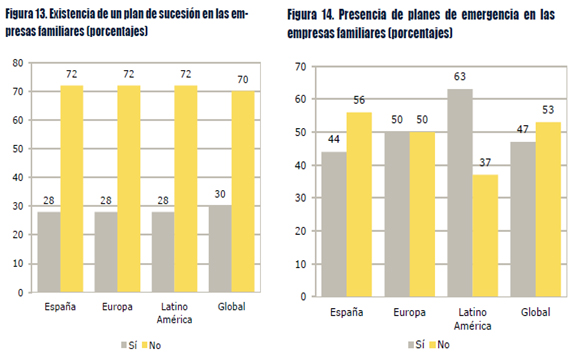
Figura 13

Having a succession plan in place suggests that family business leaders have become aware of the importance of preparing in advance for the succession process and that this process can be undertaken through reasoned criteria and in a professional manner.

The full report can be downloaded in the Knowledge section of the ASCEF website.
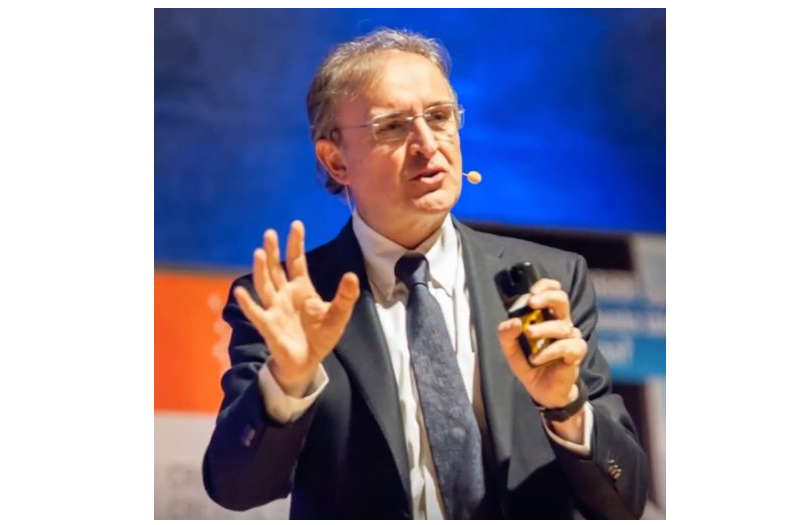
“Covid-19 has highlighted the fact that it is companies that we need to keep our society balanced and not business enterprises”

Xavier Marcet, the founder and President of the Lead to Change innovation consultancy, has given a virtual lecture entitled “The great challenges faced by family businesses in the time of Covid-19“. In the session, held jointly by the Catalan Association of Family Businesses (ASCEF) and the Cambra Chair of Family Business of the University of Girona on 11 November, he discussed the great challenges facing family businesses: the perspective of people, customer centrality and the sum of intelligence, talent and leadership.

Mr Marcet began by highlighting the importance of the difference between companies and business enterprises. “A company is a community of people with a purpose, to survive by creating customers but it always revolves around people: it generates employment and has a very important and deep-rooted history and ties to the territory; while a business enterprise can capture a great deal of value but contributes little to society,” he explained. “The problem we have with these business enterprises is that many times they are not linked to the territory, to employment or to the growth of society.

What we need to keep our society balanced are companies, communities of people where people are counted on, history is considered and there is a memory,” Mr Marcet said. “And Covid-19 has done nothing but emphasise all this.

Mr Marcet stressed throughout the session that this people’s perspective “is a key, fundamental element that characterises companies. If people are respected, customers are respected.” He went on to say that companies must not stop thinking about customers “and not stop thinking about what they need and that they do not know how to express. Not today, but tomorrow.

The coronavirus pandemic “has made it more than evident that not everything can be planned because the situation is changing every week.” In this regard, he said that “the dynamics to which we were accustomed have changed. We need to have a vision, a strategy, but to plan less. We must be able to adapt this strategy and planning in a world that changes faster than our ability to plan.

Why are we talking about flexibility? Because the world is moving fast, fluidly, and we need to be able to take decisions with uncertainty“, Mr Marcet added before explaining that, with regard to talent, “its flow, both in and out, is important“. Concerning leadership, he said that a good leader “has the ability to propose the vision and exemplify rather than to give good speeches; He is not someone who adds but who multiplies.

Finally, regarding the situation in Catalonia and what would be needed, Mr Marcet said that “it is very important to be able to maintain companies that have given us our identity, companies with the will to exist and to grow. Not just thinking about having ideas but also about implementing them.

16% of Catalan family businesses are at risk of closure

Sixteen per cent of Catalan family businesses run the risk of shutting down in 2020 due to restrictions on activity caused by the Covid-19 pandemic according to estimates by the Catalan Association of Family Businesses (ASCEF), its President, Amadeu Jori, told the EFE news agency.

He said that ASCEF is calling on the Government for greater coordination and contact with social agents “who are the ones who really know first-hand what is happening.

Mr Jori also asked administrations to provide financial injections to companies in difficulty, “not only with loans but with direct subsidies” as has been done in other European countries. “If economic activity is restricted in order to protect health, measures must be taken to prevent economic activity from collapsing,” he said.

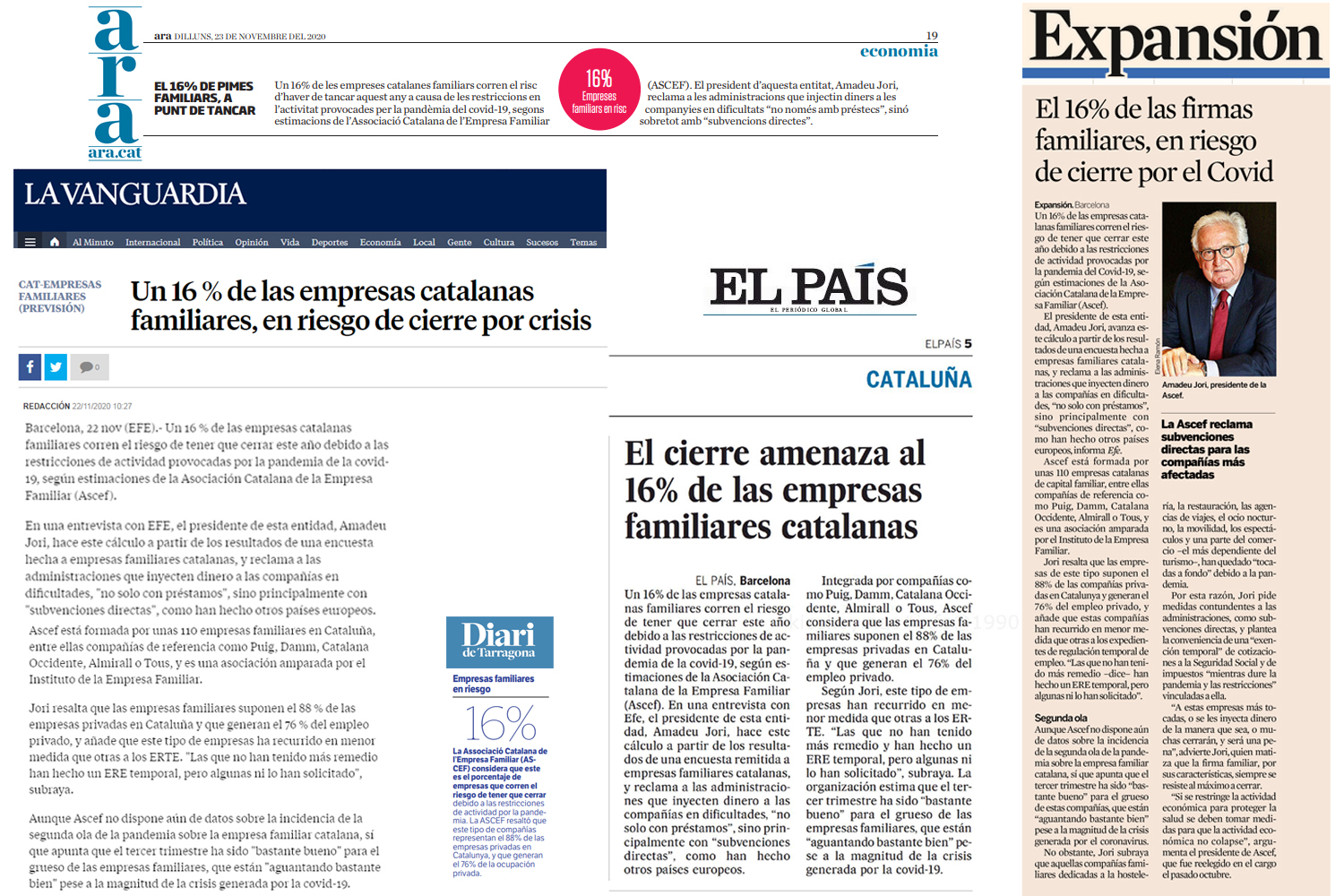
The news was echoed in the media, both in general outlets such as La Vanguardia, Diari Ara and El País, and economic ones such as Expansión.

ASCEF calls for end to delays in the Mediterranean Corridor and highlights the need for connection with the ports of Barcelona and Tarragona

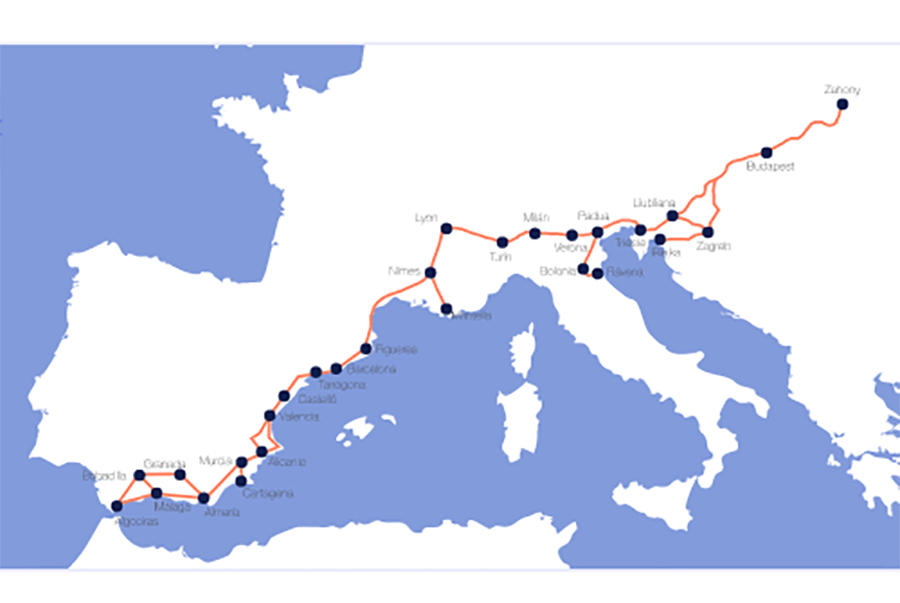
The President of the Catalan Association of Family Businesses (ASCEF), Amadeu Jori, participated at a business event held in Valencia yesterday to assess the status of the development of the Mediterranean Corridor. Catalan family businesses, like other business associations, called on the Government to ensure that the project does not undergo any further delays and is completed in 2025. The event was attended by Spain’s Minister of Transport, Mobility and Urban Agenda, José Luis Ábalos.

ASCEF acknowledged the progress made on the international gauge rail platform and the opportunity to receive investment from Community funds for economic reactivation through alignment with the requirements of the EU plan. However, the Association also requested that the connection with the ports of Barcelona and Tarragona should not be ignored and expressed its hope that the Perpinyà-Montpellier stretch does not become a bottleneck if it fails to be concluded until 2034.

A modern, fast rail freight line is a strategic infrastructure, one that is essential for the competitive development of exports in Catalonia and for companies to exploit their full potential in Europe,” Mr Jori said. Greater capacity in train traffic together with greater regularity and speed will not only facilitate logistics but will also reduce costs as rail transport is cheaper. In addition, trains cause less pollution.

Family businesses call on the Government to focus its agenda on overcoming the crisis: “Efforts cannot be diluted in divisive battles”

  • Spain tops the rankings of the countries with the highest unemployment in Europe, both in boom periods and in times of crisis; we should ask ourselves why and attempt to solve this,” Mr Puig said
  • The IEF President added that “all our efforts must be directed at enabling the maximum number of companies, and in particular the family companies that we represent and that represent a very high percentage of employment in this country, to overcome this difficult situation.”

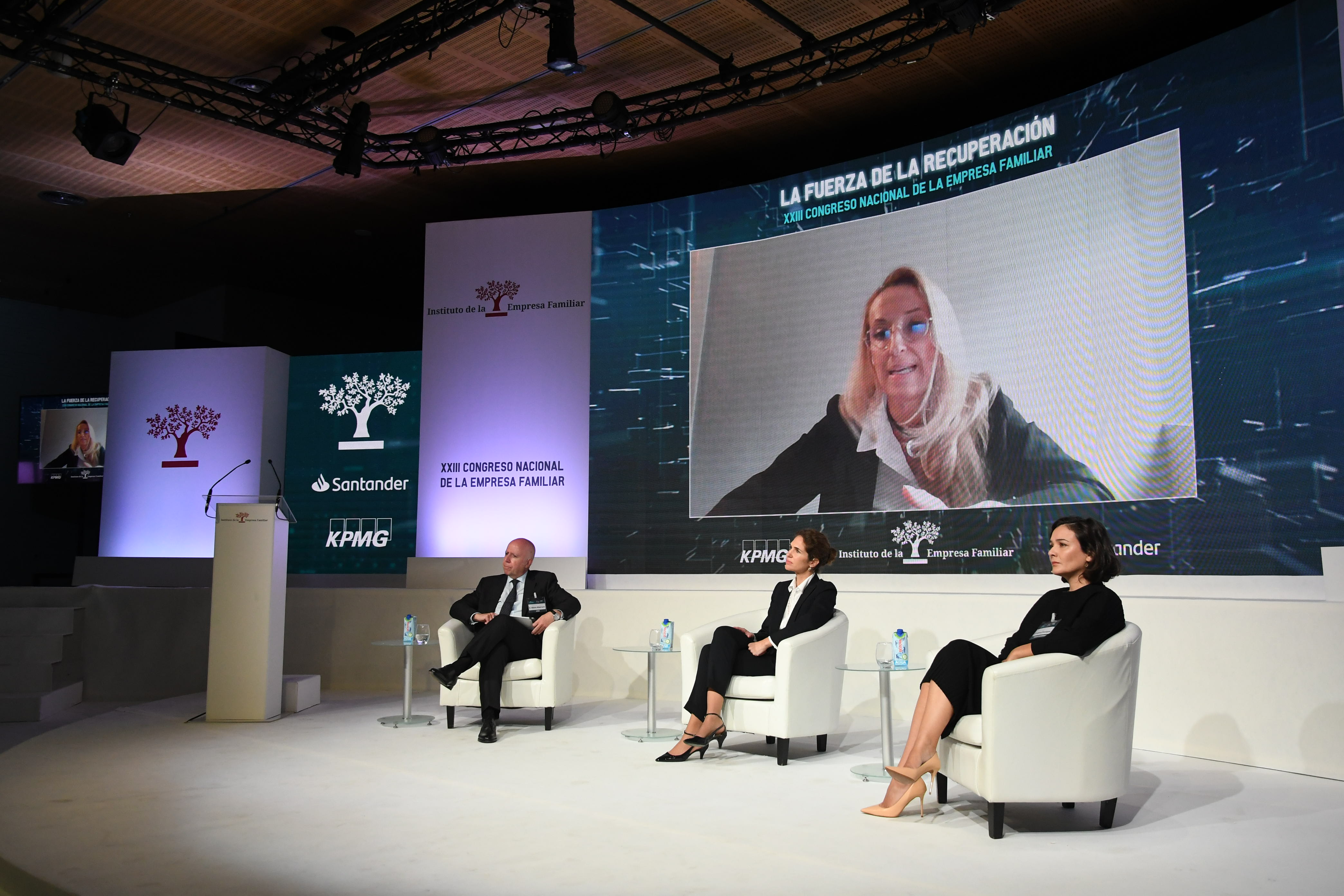
One of the Spanish Government’s four Deputy Prime Ministers, the Minister of Economic Affairs and Digital Transformation, Nadia Calviño, today closed the 23rd National Congress of Family Business, which has been held since Monday by the Institute of Family Business (IEF) and attended online by almost 1,000 family employers from all over Spain.

In his speech before Ms Calviño, Mr Puig said that “at this time, the enemy we have to fight is coronavirus and the crisis that it has entailed. When a society faces a challenge of this magnitude, it must demand that its leaders row in the same direction and join forces against that enemy. Efforts cannot be diluted in divisive battles.”

In addition to the human drama caused by the loss of life, one of the most serious consequences of this pandemic will be, according to Mr Puig, “the economic crisis that it is already causing, a crisis that is unprecedented. Although some sectors are safe, many others will be in a critical situation. Perhaps not all the companies that existed before the crisis can be saved, but many of them could survive and many others could mitigate the impact with a battery of appropriate measures. And we also enjoy the unprecedented support of European funds.”

Concern over employment
In Mr Puig’s view, “all our efforts must be directed at enabling the maximum number of companies, and in particular the family companies that we represent and that represent a very high percentage of employment in this country, to overcome this difficult situation.”

He wondered whether “conditions should be created that would make Spain the country where company development is facilitated the most and where the industrial fabric is best protected,” taking into account that “we are the country that will suffer the crisis the hardest, the one with the highest unemployment and the one that will generate the highest unemployment.!

Therefore, “the government’s agenda should be focused on this endeavour and other priorities left for other times. Let’s put aside some legislative initiatives that only place more obstacles in the way of companies and instead prioritise the protection of the business fabric, at least while our unemployment levels exceed certain pre-established thresholds. Otherwise, we will continue to top the rankings as the country that is the most affected and that has the highest unemployment in Europe, in an irreversible manner. And unemployment, among other things, we should remember, is the main generator of inequality,” he said.

A chance to modernise and develop
Despite the dramatic nature of the situation, Mr Puig said that “we have before us an opportunity to modernise, to bring about the next leap to new levels of technological, ecological and productivity development. That commitment is, at the same time, one of the keys to emerging from the pandemic crisis. The distribution of the European Union Recovery and Resilience Fund is not going to solve all our problems but it gives us a leverage that we must not squander. Family employers have a great deal to contribute, a very great deal, to ensure an efficient use of this aid that will enable Spanish companies to gain in competitiveness, create new and better jobs and emerge from this crisis.”

In this regard, Mr Puig highlighted once again “the full commitment and total readiness of the IEF to collaborate with the Government in identifying projects that fit the lines defined in the Plan España Puede (Spain Can Plan), ensuring that our institutional and disinterested collaboration will translate into tangible realities, into more efficient and competitive companies, into jobs with higher added value and into greater well-being for Spaniards.”

Mr Puig also wished to make clear that, despite everything that is happening, the Congress concluding today has not heard “the voice of despondency or the temptation to withdraw. What we have felt here, what I have the opportunity to verify daily in my conversations with many of you, is your non-negotiable commitment to the future, the indisputable desire for progress that you all display. And as we have demonstrated throughout the lives of our companies, crises are opportunities for us, through our leadership, to reinvent ourselves and face the future with renewed energy.”

Family businesses, up to the challenge
We have much of which to feel proud and satisfied but we still have more to do and achieve. Because that ambition to do things better each day is the force that makes us entrepreneurs. For this reason, it is because of our permanent commitment to our companies and to society that family businesses are companies with a future. In a few years’ time, when this virus is only a bad dream, I would like to think that family businesses have once again risen to the challenge, surmounted all this and managed to take advantage and reinvent themselves. That is why we are going to be The Force of Recovery,” he concluded.

Marc Puig: “Family businesses are vital to implement the relaunch, recovery and transformation process”

  • Under the motto ‘The Power of Recovery‘, almost 1,000 employers from all over Spain are participating in the major annual meeting of family businesses that, for the first time due to the pandemic, is being held online
  • Given the current situation, the Family Business Institute president says that many century-old family businesses have had to overcome numerous difficulties over their history: “We will do so too

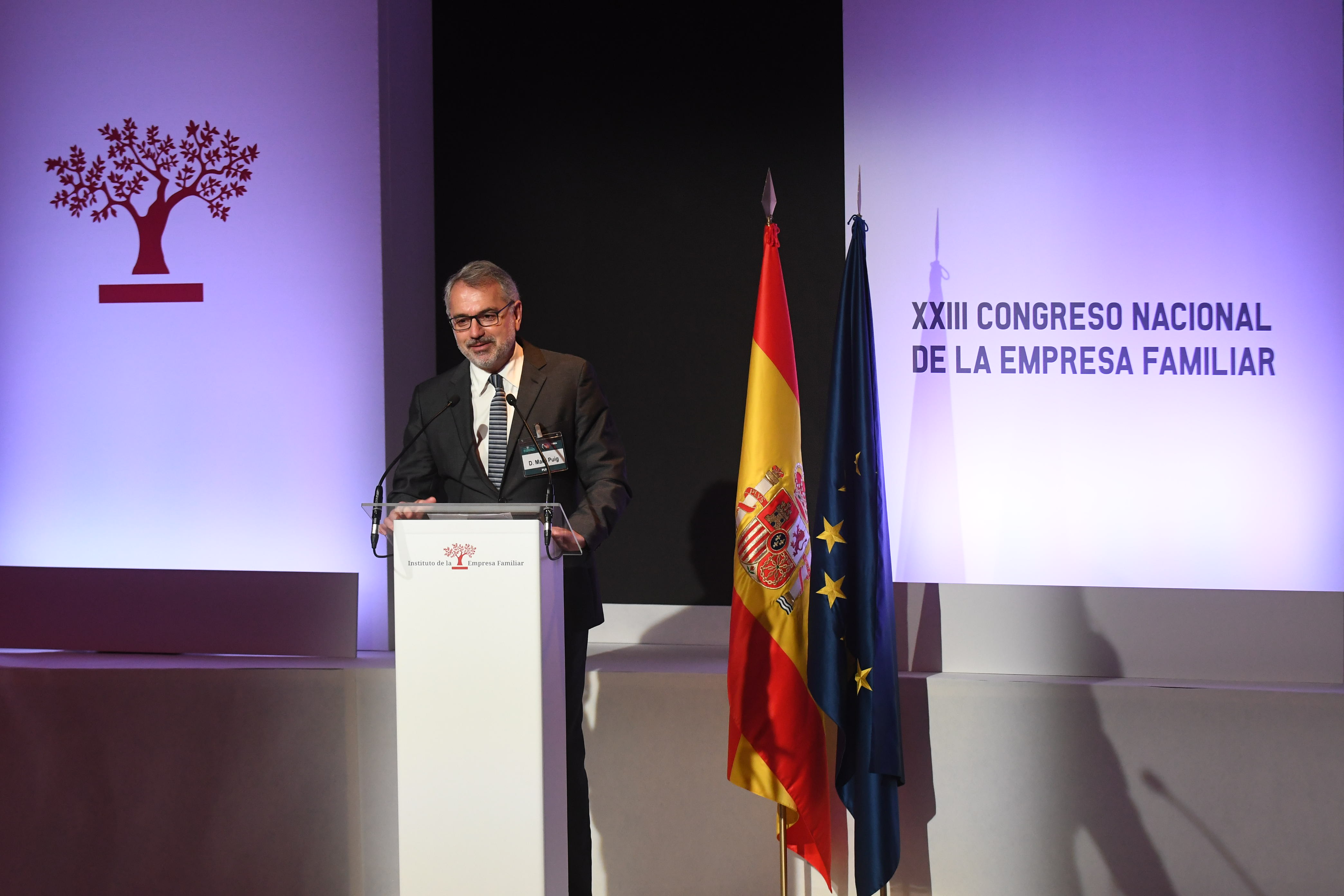
Family businesses are essential to implement the process of relaunch, recovery and transformation that our country needs to address. This is because of our values and especially our leadership capacity“, said Marc Puig, Executive President of Puig and President of the Family Business Institute (IEF), at today’s opening of the 23rd National Congress of Family Business, which due to the pandemic is being held online for the first time. This has not prevented record numbers from attending, with almost 1,000 family employers, IEF members and the Territorial Associations of Family Businesses using the digital platform created for this purpose.

The Congress was opened by His Majesty King Felipe VI, who said in his speech that the crisis generated by Covid-19 “is a real challenge for Spain. And it is in these difficult times when we families, companies, institutions have to demonstrate our resilience and our willingness to join forces and find solutions that serve the short, medium and long term.”

For his part, Mr Puig thanked the Monarch for his attendance and recalled Felipe VI’s recent speech when he said that “to emerge from the crisis caused by the pandemic we are obliged to set a new economic course and promote a new development model that has inclusion as its basis.

This is already a global movement. We saw this at the time with the statement of the United States Business Roundtable, which proposed to distance itself from the doctrine of Milton Freidman, summarised in the headline of the famous article he published in 1970 that declared the maximisation of capital returns as the sole aim of business activity,. Well, not everything may be reduced solely to profit,” Mr Puig said.

On the contrary, the IEF President added, “our stance is that companies must simultaneously create economic prosperity and social value.” This is precisely “the characteristic of family businesses. Their time frame is counted in generations, not in quarters or days. And this gives us a different way of managing people; with the desire that they should remain in the company for a long time, fomenting training and internal promotion; even in times of crisis, family businesses are more resilient in the face of job destruction; with a value system that befits a family, with a different manner of establishing long-term relationships with suppliers and customers; and also a manner of relating to the community in which we operate, with a family’s desire to protect reputation and legacy, which roots us more in the territory and in the communities in which we operate. And as we think of forthcoming generations and the world that we will leave to them, we embrace the initiatives of environmental protection and sustainability.”

Values and leadership capacity
Mr Puig explained that the motto of this year’s Congress, THE FORCE OF RECOVERY, was chosen because “this is the idea that we wish to convey to society and institutions: that family businesses are essential to implementing the process of relaunch, recovery and transformation that our country needs to address. This is because of our values and, especially, our leadership capacity, which is accredited in some of the companies represented here, with some boasting over a century of history.

In addition to institutional and political representation, the Congress programme also includes the presence of business and science representatives as well as IEF associates so as to provide a refined vision of the panorama we are facing and a clear message about the major contribution that family businesses are already making towards the resolution of the crisis we are experiencing.

Niño-Becerra and Sánchez-Llibre agree on highlighting the worth of family businesses and the importance of staying alert to opportunities

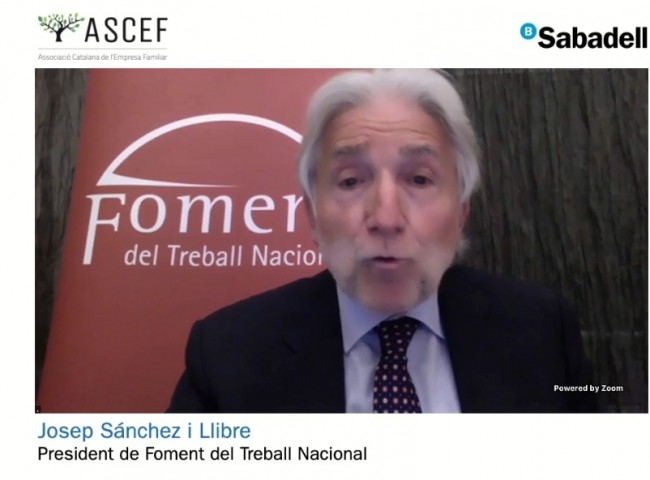
Santiago Niño-Becerra, who is a Doctor of Economics, professor and author, and Josep Sánchez i Llibre, the President of Foment del Treball Nacional, were among the participants at the 22nd Ordinary and Extraordinary Assembly of the Catalan Association of Family Businesses (ASCEF), which was held online on Tuesday, October 6.

Professor Niño-Becerra gave a talk entitled The Breaking of Trends: The New Normal, in which he examined the situation caused by a pandemic “that has broken economic trends.” He added that “to find a situation in Spain similar to the one experienced between the months of December and May we have to go back to the Civil War.”

The Professor explained that Spain’s main problem is “tax fraud” but that the country also “has a problem with income and expenditure, and a major problem with productivity.” In Niño-Becerra’s view, the Covid-19 virus and its consequent crisis has had a far greater effect on Spain “because its economy was already bad previously.”

The survivors of this situation will be those with knowledge tools to navigate this complex world, those who master innovative tools or those with a good liquidity cushion,” he said. “It will be important to create added value and to specialise; to be a sectoral leader: to be in the upper layer of added value and productivity.”

Josep Sánchez i Llibre, the President of the Foment del Treball Nacional

The Assembly was closed by Mr Sánchez i Llibre, the President of Foment del Trebrall, who said that “employers are the only ones who can overcome the crisis and salvage the current situation because we generate employment and wealth.

The crisis will generate new opportunities that family businesses will have to put into practice,” said Mr Sánchez i Llibre, who called for the general budgets for 2021 “to be a great stimulus for economic recovery, with much public investment to increase productivity, stimulate demand and boost the economy.

Today’s economic situation is very delicate,” he added before acknowledging “the great effort made by family businesses” in this context.

The 85% of Catalan family employers fear that a lack of political consensus will lead to the late arrival of the European recovery funds

Barcelona, Octobrer 7, 2020.- 85% of Catalan family businesses believe it is unlikely that the European recovery funds will arrive promptly, mainly due to the lack of agreement among politicians. “Not only because of the changing views within the EU but also because of the lack of consensus among our country’s politicians, which generates a negative image internationally that damages our capacity of influence,” said Amadeu Jori, the President of the Catalan Association of Family Businesses (ASCEF). “These funds are a vital instrument for economic recovery.

With regard to the measure announced today by Spanish Prime Minister Pedro Sánchez to advance a first payment of 27.436 billion euros from these funds, the ASLEF President said that this is “a good initiative that is in tune with what we employers are calling for.

At a time such as this, ASCEF members say that their principal concern is falling sales, followed by employee safety and labour reform. In an opinion poll canvassing Association members, the employers responded that, in parallel to the political debate, they are already taking action to address the crisis. This mainly involves innovating and creating new products, reducing costs, improving training to increase productivity and promoting digitisation.

In Mr Jori’s view, these initiatives alone are insufficient and it is also necessary for public administrations to stimulate the economy and apply measures to protect companies and jobs.

As a consequence of the situation experienced by companies, 68% of family employers believe that the economy will not show a quick recovery but will do so in the shape of a letter K; that is, first a sharp decline followed by a progressive recovery although this will not be across the board but will relate to sectors.

In the face of the second wave of the pandemic, 61% of Catalan employers think that the central government will be forced to choose between economy and health, while 37% believe that this will depend on the intensity of infections. In this regard, employers stress the importance of rigour in the application of protective measures and call for responsibility.

Furthermore, half of Catalan family employers (51%) believe that Covid-19 and the measures that have had to be taken have strained relations between regional institutions and central government.

The ASCEF is an organisation of family employers that draws over 100 companies representing the economic fabric of Catalonia. Family businesses account for 88.3% of all private companies, contribute 69% of Gross Value Added (GVA) and generate 76% of private jobs.

THE ASCEF Board of Directors is renewed

The Catalan Association of Family Businesses (ASCEF) announced during its 22nd Ordinary and Extraordinary Assembly on Tuesday that its Board of Directors is to be renewed, with five newcomers to replace four departing members. The governing body has also decided on a change in the presidency of the Executive Committee of the ASCEF Forum, the group that draws young members of business families.

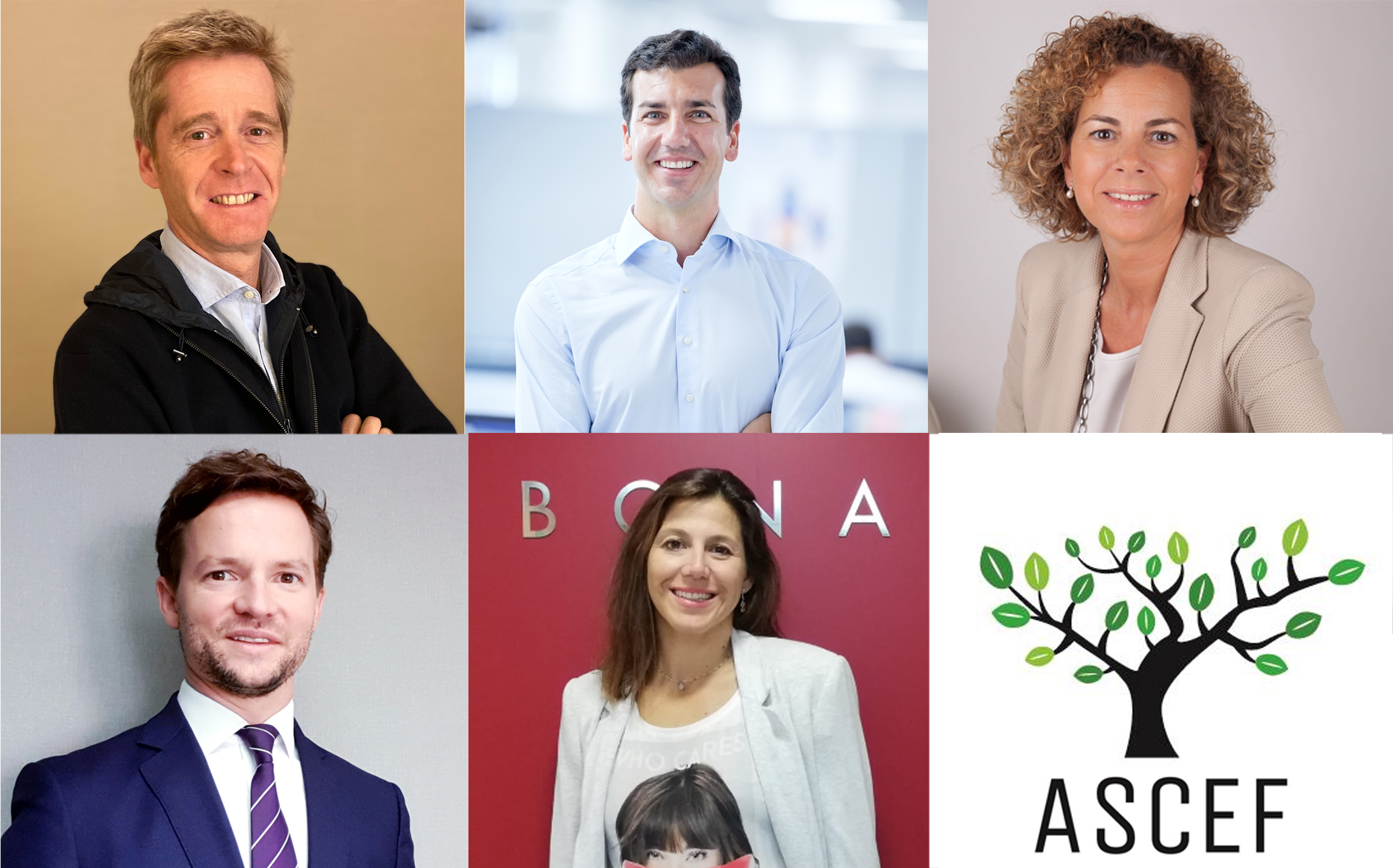
In accordance with the Association’s Statutes, the Board of Directors is renewed every three years. Amadeu Jori, on behalf of Jori Armengol & Associats, will retain the Presidency and will be joined by new members Ricard Aubert, for Simon Holding, Ignasi Botet for Caboel, Albert Campabadal for the Grupo Sifu, Diana Ganduxer for Grup Bonanova and Eva Lluch, for Lluch Essence.

The outgoing members are Immaculada Amat, on behalf of Amat Immobiliaris, Antoni Cammany, for EPI – Industries Family of Companies, Jesús Mora for JEMI, and Jordi Torres for Santiveri. ASLEF would like to thank them for their dedication and work on the Board over recent years on behalf of our members.

With the changes, the composition of the Board is as follows:

The change of the Presidency in the Executive Committee of the ASCEF Forum announced at the Ordinary and Extraordinary Assembly will see Ricard Oller replace Albert Campabadal, who remains part of the management body that draws young people aged 18-45 from Catalan business families.

The other members of the Forum’s Executive Committee are Carlos Alsina, Albert Borràs, Olga Carbó, Anna Guixà, Marc Morillas, Míriam Pujol, Guillermo Vidal i Juan Enrique Yxart Romeu.

Ana Fisas: “The present situation calls for perseverance, decisiveness and energy, three qualities that we women possess”

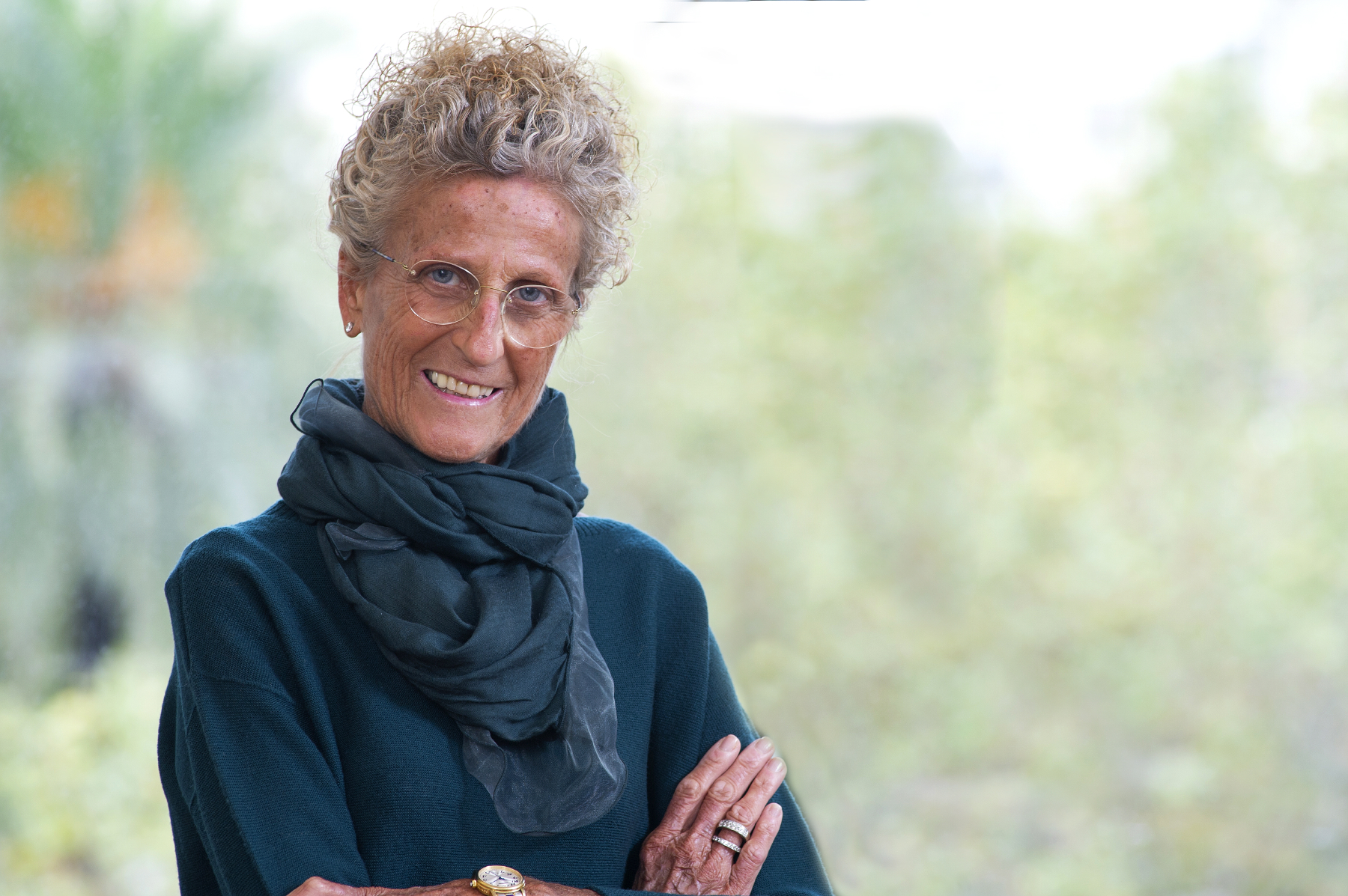
The new normal and the second wave of the pandemic require the business fabric to adapt and react to events. For Ana Fisas, the President of the Vamos a Compartir” (We will share) group, which comprises 30 businesswomen and forms part of the Catalan Association of Family Businesses (ASCEF), the increasing numbers of women in managerial positions is a differential value for many companies “because the present situation requires decisiveness, perseverance and great energy, three qualities that we women possess.”

In this new reality, it is important to facilitate work-life balance for both men and women through measures that focus on flexible schedules and physical presence at company premises. “However, this is only possible if the employer introducing these measures shows sensitivity and if the employee shows individual responsibility and commitment,” she says.

Ms Fisas sees our society as “open and committed” although there is still much to do in the areas of gender equality, access to decent work, poverty and various others.

The “Vamos a Compartir” group seeks to promote debate on issues related to social justice and the empowerment of women.

If you need more information contact us ascef@ascef.com